
Dollar, Pound, Euro — How to Hold Foreign Currency Legally in a Nigerian Bank
Every Nigerian who earns in foreign currency, receives remittances from abroad, runs an export business, pays school fees in dollars, or simply wants to protect savings from naira devaluation should understand one thing clearly: a domiciliary account is not a luxury product. It is the most straightforward, legal, and practical way to hold and use foreign currency inside the Nigerian banking system.
A domiciliary account — commonly called a dom account — is a bank account denominated in foreign currency rather than naira. You deposit dollars, pounds, or euros into it. The money sits in those currencies. You withdraw in those currencies. No conversion happens unless you choose to convert. Any Nigerian resident with a BVN and valid means of identification can open one. And with naira inflation consistently eroding purchasing power, holding even a portion of savings in foreign currency has become one of the most sensible financial decisions an ordinary Nigerian can make.
This guide walks through exactly how to open a domiciliary account in 2026 — what documents you need, which banks offer the best terms, the step-by-step process, and what the account actually allows you to do.
What Is a Domiciliary Account and Who Needs One?
What it is: A domiciliary account is a foreign currency account held at a Nigerian commercial bank, denominated in US Dollars (USD), British Pounds (GBP), or Euros (EUR). It allows you to receive, hold, and withdraw foreign currency without mandatory conversion to naira.
Who qualifies: Any Nigerian resident with a BVN and valid ID can open a domiciliary account. You do not need to be a business owner, a frequent traveller, or a high-net-worth individual. The account is available to individuals, sole proprietors, and corporate entities.
Who needs one most:
Freelancers, remote workers, and consultants receiving payment in foreign currency from international clients. Nigerians receiving remittances from family abroad. Business owners importing goods and paying international suppliers. Students or parents paying school fees at foreign universities. Anyone wanting to legally save in dollars to hedge against naira devaluation. Exporters receiving payment for goods sold to foreign buyers.
Important note: Holding dollars in a Nigerian bank account is not a grey area — it is legal, regulated by the CBN, and fully supported by all major commercial banks.
Documents Required to Open a Domiciliary Account in Nigeria 2026
The document requirements are largely the same across all major Nigerian banks, with minor variations.
Document | Details
Valid government-issued ID | International Passport (most preferred), National ID Card, or Driver’s Licence
BVN (Bank Verification Number) | Mandatory for all Nigerian bank accounts — no exceptions
NIN (National Identification Number) | Required at most banks alongside BVN
Two recent passport photographs | Standard size; some banks now accept selfies via app for existing customers
Recent utility bill | Electricity, water, or DSTV bill not older than three months — used for address verification
Completed account opening form | Available at the bank branch or downloadable from the bank’s website
Two referee forms | Most banks require two referees who hold active current accounts at that bank or other Nigerian banks
Initial opening deposit | Typically $100, £100, or €100 in the foreign currency of your choice
Additional requirements for corporate or business domiciliary accounts:
Certificate of Incorporation (CAC registration). Board Resolution authorising account opening. Tax Identification Number (TIN). Valid IDs and photographs of all directors and authorised signatories. Proof of source of funds (required at some banks for high-value accounts).
Important note: You cannot open a domiciliary account without a BVN. This is a CBN requirement that applies to all Nigerian bank accounts regardless of currency.
Step-by-Step: How to Open a Domiciliary Account in Nigeria
Step 1: Choose Your Bank
Not all banks offer equally good domiciliary account services. GTBank, Access Bank, Zenith Bank, First Bank, and UBA are the most popular choices. Consider the bank you already have a naira account with, since existing customers often face less friction. Also consider which bank your international transfers will arrive from — some remittance services credit specific Nigerian banks faster than others.
Step 2: Gather Your Documents
Collect all the documents listed above before visiting the branch. Bring originals and photocopies of your ID and utility bill. Have your BVN and NIN numbers written down. Prepare your referee forms — most banks provide blank referee forms for you to take to your referees before submitting the full package.
Step 3: Visit Your Chosen Bank Branch
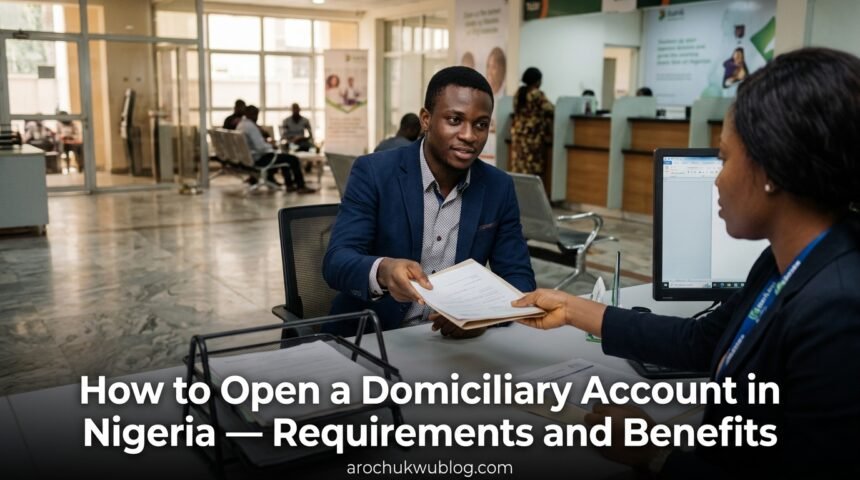
Domiciliary accounts generally require a physical branch visit for document submission and biometric capture. Walk to the customer service desk and inform the officer that you want to open a domiciliary account. They will provide the account opening form if you did not download one in advance.
Step 4: Complete the Account Opening Form
Fill out the form carefully. Specify the currency — USD, GBP, or EUR — and the type of account (personal or business). Submit the completed form together with all your documents.
Step 5: Submit Referee Forms
Some banks require two referees who have active current accounts. Your referees fill out their own section of the form, which you then submit as part of your package. Some banks are relaxing this requirement for personal accounts — confirm with your specific bank before visiting.
Step 6: Make Your Opening Deposit
Most major Nigerian banks require a minimum initial deposit of approximately $100 (or equivalent in GBP or EUR) to activate the account. This deposit must be made in the foreign currency — you cannot deposit naira at opening and have it converted. Bring the physical cash or arrange an electronic transfer as your opening deposit.
Step 7: Complete Biometrics
Fingerprint capture is typically required for all new bank customers in Nigeria as part of BVN verification and identity confirmation.
Step 8: Collect Your Account Details
After processing — which typically takes one to three working days — the bank will provide your domiciliary account number. You can then share this number with anyone sending you foreign currency internationally.
Domiciliary Account Requirements by Bank 2026
Bank | Minimum Opening Deposit | Referees Required | Currencies Available | Notable Features
GTBank | $0 (no minimum specified) | 2 (GTBank or other bank current account holders) | USD, GBP, EUR | Strong international transfers, wide branch network
Access Bank | $100 | 2 (current account holders) | USD, GBP, EUR | No minimum operating balance after opening
Zenith Bank | $0 (zero balance account) | 2 (current account holders) | USD, GBP, EUR | Zero opening balance, cash withdrawals, foreign transfers
First Bank | $50 – $100 (varies by branch) | 2 (current account holders) | USD, GBP, EUR | Nigeria’s oldest bank, wide trust base
UBA | $100 | 2 (current account holders) | USD, GBP, EUR | DOM balance usable as collateral for naira loans
Stanbic IBTC | $100 | 2 (current account holders) | USD, GBP, EUR | Seamless switching between naira and dom accounts
FCMB | $100 | 2 (current account holders) | USD, GBP, EUR | Standard commercial bank terms
Fidelity Bank | $100 | 2 (current account holders) | USD, GBP, EUR | Standard terms
Important note: Requirements vary by branch and can change. Always confirm the current minimum deposit and referee requirements directly with your specific bank before visiting.
Benefits of a Domiciliary Account in Nigeria
Hedge against naira devaluation: This is the single most powerful reason most Nigerians open a dom account. The naira has depreciated significantly against the dollar over the past decade. Money held in a domiciliary account retains its value in the foreign currency — the naira devaluation does not touch it unless you choose to convert.
Receive international payments directly: Freelancers, remote workers, and exporters can receive dollar or pound payments directly into a CBN-regulated Nigerian bank account without relying on third-party fintech intermediaries.
Pay international invoices: Make payments to foreign suppliers, pay international school fees, or buy goods abroad directly from your domiciliary account without purchasing foreign exchange through a parallel market.
Use as collateral for naira loans: At UBA and some other banks, your domiciliary account balance can be used as collateral for naira-denominated loans, giving you access to cheap naira credit without converting your dollars.
Withdraw in foreign currency: Unlike other foreign-currency products, a domiciliary account allows you to physically withdraw the foreign currency — dollars, pounds, or euros — in cash from a bank branch.
Joint signatory option: Available at most banks, making it useful for family savings or business accounts with multiple authorised signatories.
Domiciliary Account vs Regular Naira Account — Key Differences
Feature | Domiciliary Account | Regular Naira Account
Currency held | USD, GBP, EUR | Nigerian Naira (NGN)
Naira devaluation impact | None (until you convert) | Full impact of devaluation
Who can open it | Any Nigerian with BVN and ID | Any Nigerian with BVN and ID
Minimum opening deposit | ~$100 | Often zero or ₦1,000
Used for international transfers | Yes | Restricted
Used for international payments | Yes | Limited
Debit card available | At some banks | Standard
Interest earned | Minimal (0–2% annually at most) | Standard savings rates apply
Domiciliary Account Fees and Charges to Know
Before opening, understand the typical fee structure. These vary by bank but the major categories are:
Fee Type | Typical Amount
International wire transfer (outgoing) | $40 – $50 telex charge plus 0.5% of transaction amount
Account maintenance fee | Varies — some banks charge quarterly maintenance fees
ATM withdrawal fee | Varies by bank and ATM
SMS notification charge | Standard bank SMS fee applies
Important note: Ask about all fees before signing anything. Some banks charge significantly more for outgoing international transfers than others. If you plan to send money abroad regularly, compare the telex and transfer fees carefully before choosing your bank.
Can You Open a Domiciliary Account Online in Nigeria?
As of 2026, most major Nigerian commercial banks still require a physical branch visit for new domiciliary account customers, as biometric verification is part of the process. However, there are partial online options:
GTBank, Access Bank, and Zenith Bank have all offered online or app-based dom account opening for existing customers who already have a naira account with the same bank. New customers opening their very first account at any bank will almost always need to visit a branch in person. Some banks are piloting digital dom account opening — check with your specific bank to see whether this is available for your tier.
Frequently Asked Questions
Can I deposit naira into a domiciliary account?
No. A domiciliary account only accepts foreign currency. You cannot deposit naira and have it converted at opening or at any subsequent deposit. The account is strictly for foreign currency transactions.
How do I receive money into my domiciliary account from abroad?
Share your bank’s SWIFT code, your account number, your account name, and the bank branch address with the sender. These details are all available from your bank at the time of opening.
What is the best bank for a domiciliary account in Nigeria?
GTBank, Access Bank, and Zenith Bank are the most commonly recommended for their wide branch networks, strong international banking relationships, and relatively smooth account opening processes. The best bank is ultimately the one you already bank with — switching is unnecessary if your current bank offers good dom account terms.
Does a domiciliary account earn interest?
Very little. Domiciliary accounts in Nigeria typically earn minimal or no interest. They are savings and transaction tools, not high-yield investment accounts.
Can a student open a domiciliary account in Nigeria?
Yes, provided they meet the standard requirements — BVN, valid ID, utility bill, and the opening deposit. Age restrictions follow standard bank account rules.
Are you a Nigerian freelancer, remote worker, or business owner trying to figure out the best way to receive and hold foreign currency legally? Drop your question in the comments — we break down Nigerian banking requirements and account options in plain language at arochukwublog.com.