
The ₦70,000 Question Every Nigerian Worker Is Asking
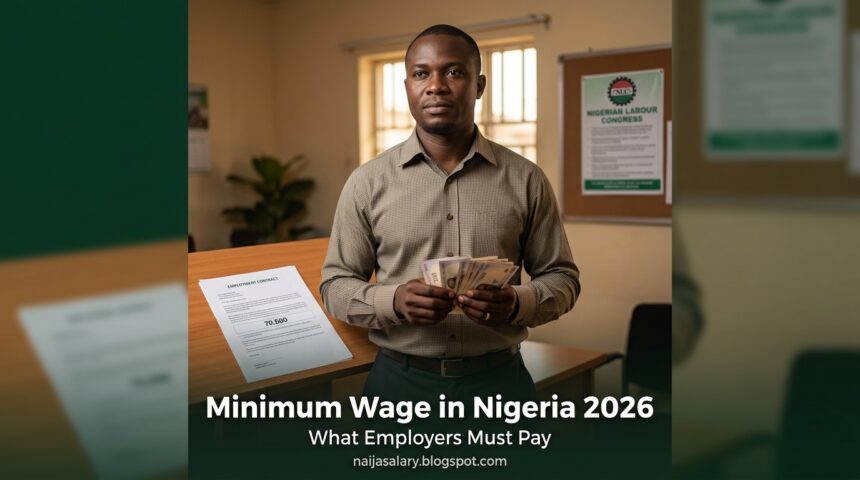
On the 29th of July 2024, President Bola Ahmed Tinubu signed into law a new National Minimum Wage of ₦70,000 per month — the most significant upward revision in Nigeria’s minimum wage history, representing a 133% increase from the previous ₦30,000 minimum that had been in place since 2019.
- The ₦70,000 Question Every Nigerian Worker Is Asking
- The Current Nigerian Minimum Wage
- A Brief History of Nigeria’s Minimum Wage
- Who Does the Minimum Wage Apply To?
- Who Is Exempt From the National Minimum Wage?
- State Minimum Wages — Which States Pay More
- What the ₦70,000 Minimum Wage Actually Means for Workers
- Penalties for Employers Who Pay Below the Minimum Wage
- How to Report an Employer Paying Below Minimum Wage
- Minimum Wage and PAYE — The Important Exemption
- What to Do If You Are a Minimum Wage Employer
- The Minimum Wage and Nigeria’s Economic Reality
For millions of Nigerian workers earning at or near the bottom of the wage scale, this was news that mattered enormously. For employers across the country — from small businesses to state governments to large corporations — it was a legal obligation that came with immediate compliance requirements and real penalties for non-compliance.
Yet despite the significance of this law and the public attention it received at signing, the reality on the ground in Nigeria in 2026 is mixed. Some employers — particularly federal government institutions, large banks, oil companies, and established corporations — comply fully. Others — particularly small businesses, state governments still negotiating, and informal employers — comply partially or not at all.
This guide gives every Nigerian worker and employer the complete, accurate picture of Nigeria’s minimum wage law — what it requires, who it covers, what the penalties are for non-compliance, and what you can do if your employer is paying below the legal minimum.
The Current Nigerian Minimum Wage
The current National Minimum Wage is ₦70,000 per month.
This was established by the National Minimum Wage Act (Amendment) 2024, signed into law on July 29, 2024. It replaced the previous national minimum wage of ₦30,000 which had been in effect since April 2019.
The ₦70,000 applies as a monthly gross salary — meaning this is the minimum amount an eligible employee must receive before any statutory deductions (PAYE, pension, NHF, NHIS) are applied.
Important clarification: ₦70,000 is the national floor — the minimum any covered employer can legally pay. Nothing in the law prevents employers from paying more, and many do. The minimum wage is a legal floor, not a recommended salary.
A Brief History of Nigeria’s Minimum Wage
Understanding how Nigeria’s minimum wage has evolved helps put the current ₦70,000 in context:
1991: ₦3,500 per month — the first significant minimum wage under General Ibrahim Babangida’s military government.
2000: ₦7,500 per month — increased under President Olusegun Obasanjo’s civilian administration.
2011: ₦18,000 per month — signed by President Goodluck Jonathan following extensive NLC agitation and national strikes. This figure remained in place for eight years.
2019: ₦30,000 per month — signed by President Muhammadu Buhari in April 2019 after prolonged negotiations with organised labour. A 67% increase from ₦18,000.
2024: ₦70,000 per month — signed by President Bola Tinubu in July 2024 following intense labour pressure, threatened strikes, and negotiations that produced a figure significantly higher than the government’s initial offer of ₦60,000.
The trajectory shows that Nigeria’s minimum wage revisions have historically been irregular — happening roughly every five to eight years — driven more by labour agitation than by systematic, inflation-indexed adjustment mechanisms. Each revision has come after significant periods where the real value of the minimum wage was eroded by inflation.
Who Does the Minimum Wage Apply To?
The National Minimum Wage Act applies to all employers with 25 or more employees in Nigeria.
This covers:
Federal Government establishments — all federal ministries, departments, and agencies are required to pay at minimum ₦70,000 per month to all covered employees.
State Government establishments — all state civil services, parastatals, and agencies are covered by the national minimum wage. However, states retain the right to set a higher minimum for their own employees through state-level legislation.
Local Government Councils — all 774 local government areas are required to comply with the national minimum wage for their direct employees.
Private sector employers with 25 or more employees — any private business, company, or organization employing 25 or more people is legally required to pay at minimum ₦70,000 per month to all covered employees.
Who Is Exempt From the National Minimum Wage?
Several categories of workers are explicitly or practically excluded from the coverage of the National Minimum Wage Act:
Domestic servants and household workers: Cooks, house helps, stewards, drivers employed by private households — not businesses — are exempt from the national minimum wage provisions. This exemption has been widely criticized by labour advocates as it leaves some of Nigeria’s most vulnerable workers outside legal wage protections.
Establishments with fewer than 25 employees: Small businesses employing fewer than 25 people are not covered by the minimum wage law. This is a significant exemption given that the vast majority of Nigerian businesses are small enterprises.
Part-time workers in some interpretations: While not explicitly excluded by the act in all circumstances, part-time workers’ minimum wage entitlements are sometimes calculated on a pro-rata basis relative to their working hours.
Apprentices under formal apprenticeship agreements: Apprentices in certified apprenticeship programmes may receive below minimum wage during their training period under specific arrangements.
Agricultural workers in some contexts: Farm workers employed on casual or seasonal terms in agricultural settings are sometimes treated outside minimum wage coverage in practice, though the legal position is contested.
State Minimum Wages — Which States Pay More
While the national minimum wage sets the floor, individual states in Nigeria have the constitutional power to set higher minimums for employees in their states and in their own civil services.
Several states moved quickly to announce state-level wages either at or above the national minimum:
Rivers State announced a state minimum wage of ₦85,000 per month — significantly above the national floor — in the period following the federal announcement. This makes Rivers State one of the highest minimum wage states in Nigeria.
Lagos State initiated its own review process following the federal minimum wage announcement, with various figures discussed in the context of the higher cost of living in Lagos relative to other parts of Nigeria.
Several other states announced compliance with the ₦70,000 national minimum while beginning negotiations with state-level unions regarding implementation timelines and salary structure adjustments.
The practical reality: The announcement of compliance with minimum wage legislation by state governments does not always translate immediately into actual payment. Many Nigerian states have historically announced minimum wage compliance while taking months or years to actually implement the payments — often citing insufficient revenue from federal allocations.
What the ₦70,000 Minimum Wage Actually Means for Workers
When the ₦70,000 minimum wage was announced, significant public debate arose about whether it was sufficient for Nigerian workers to live on. This debate continues in 2026 and is worth understanding.
What ₦70,000 Per Month Covers
For a single worker in a lower-cost Nigerian city — not Lagos or Abuja — ₦70,000 per month provides:
Housing: A room in a shared apartment or a self-contained one-room in a smaller city typically costs ₦10,000 to ₦20,000 per month when paid monthly or ₦120,000 to ₦240,000 annually. This represents 14% to 28% of minimum wage income.
Food: Basic food budget for one person — market ingredients for cooking at home — typically ₦15,000 to ₦25,000 per month in 2026 prices.
Transportation: Daily transport to work in a typical Nigerian city — ₦500 to ₦1,500 per day, or approximately ₦10,000 to ₦30,000 per month depending on distance.
Utilities: Generator fuel, electricity prepaid tokens, water — approximately ₦5,000 to ₦15,000 per month.
This basic budget already consumes ₦40,000 to ₦90,000 — meaning ₦70,000 barely covers essentials for a single person in most Nigerian cities, and leaves virtually nothing for a worker with dependants.
In Lagos and Abuja, where costs are significantly higher, ₦70,000 falls well short of covering basic expenses without supplementary income or family support.
The Living Wage Argument
Labour economists and worker advocacy groups in Nigeria consistently argue that the national minimum wage should be distinguished from a living wage — the amount a worker actually needs to meet their basic needs and those of their family.
The Nigerian Labour Congress (NLC) had demanded ₦615,000 per month as a living wage before settling for ₦70,000 in negotiations — a figure that reflects how enormous the gap between the legal minimum and a genuine living wage is in Nigeria’s current economic environment.
Penalties for Employers Who Pay Below the Minimum Wage
The National Minimum Wage Act provides for penalties against employers who fail to comply:
First offence: A fine of not less than the total amount of the difference between the minimum wage and the wages actually paid. The employer must also make good the underpayment to the affected employees.
Continuing offence: Additional fines for each day the offence continues after conviction.
Imprisonment: In cases of persistent or egregious non-compliance, the act provides for imprisonment of responsible officers of the company.
Back pay obligations: Courts can order employers to pay workers all the wages they should have received going back to the date the minimum wage took effect — meaning non-compliance can accumulate into significant financial liability.
In practice, enforcement of minimum wage penalties in Nigeria has historically been inconsistent. Large employers in the formal economy are most likely to face enforcement action. Small informal employers are significantly less likely to face scrutiny, which contributes to the gap between the law and lived reality for many workers.
How to Report an Employer Paying Below Minimum Wage
If your employer is paying below the national minimum wage and you believe you are covered by the act, you have several options:
Step One: Internal resolution. Raise the issue formally with your HR department or employer in writing. Some below-minimum wage situations arise from administrative oversight or misunderstanding of the law rather than deliberate non-compliance. A written request citing the National Minimum Wage Act sometimes resolves the situation without external escalation.
Step Two: Labour union. If your workplace has a registered trade union affiliated with the Nigeria Labour Congress (NLC) or the Trade Union Congress (TUC), bring the issue to your union representative. Labour unions have legal mechanisms to compel employer compliance through collective bargaining and grievance procedures.
Step Three: State Ministry of Labour. File a complaint with the Ministry of Labour and Employment in your state. The ministry has inspectors empowered to investigate wage violations and compel compliance.
Step Four: National Industrial Court. For cases that cannot be resolved through the ministry, the National Industrial Court of Nigeria has jurisdiction over employment and labour disputes and can make binding orders requiring employers to pay outstanding wages plus the applicable minimum.
Important caution: Nigerian workers who report minimum wage violations sometimes face informal retaliation from employers — dismissal, demotion, or hostile treatment. While such retaliation is illegal, the practical risks are real. Consider your specific employment situation carefully before escalating, and if you proceed, document everything in writing from the start.
Minimum Wage and PAYE — The Important Exemption
One important practical implication of the minimum wage level relates to PAYE tax.
The Finance Act 2019 introduced a PAYE exemption for employees earning at or below the national minimum wage. Under this provision, an employee whose gross income does not exceed the national minimum wage in a given year is exempt from paying any PAYE.
This means:
- An employee earning exactly ₦70,000 per month (₦840,000 per year) pays zero PAYE
- An employee earning ₦70,001 per month technically falls above the minimum and their taxable income (after CRA and deductions) may generate a small PAYE liability
- In practice, the Consolidated Relief Allowance and other deductions mean that very low-income earners pay minimal PAYE even slightly above the minimum wage threshold
This exemption is an important protection for minimum wage earners — ensuring that the legal floor is actually what workers take home rather than being eroded by tax deductions.
What to Do If You Are a Minimum Wage Employer
If you run a business with 25 or more employees that was previously paying below ₦70,000, here is your legal compliance checklist:
Review all employee salaries immediately against the ₦70,000 floor. Any employee earning below this amount must be brought to minimum wage level.
Calculate back pay obligations. From the date the law took effect (July 29, 2024), any underpayment represents a legal liability. Calculate and settle all back pay as quickly as possible.
Update your payroll system. Ensure your payroll software and processes reflect the new minimum wage correctly for all relevant employees.
Consider your overall salary structure. When a minimum wage increase compresses the gap between entry-level and more experienced workers, it often requires a review of the entire salary structure to maintain appropriate differentials and prevent experienced staff from feeling undervalued.
Budget realistically. A minimum wage increase of this magnitude — from ₦30,000 to ₦70,000 — has real cost implications for labour-intensive businesses. Businesses that had not budgeted for this should seek financial advice on restructuring operations sustainably while maintaining compliance.
The Minimum Wage and Nigeria’s Economic Reality
The tension between what the minimum wage law requires and what Nigeria’s broader economy can sustainably support is one of the most difficult conversations in Nigerian labour policy.
For workers, any minimum wage is better than none — and the 2024 increase to ₦70,000 was a hard-won gain that improved the incomes of millions of Nigeria’s lowest-paid formal sector employees.
For small employers, particularly those in sectors with thin margins, compliance with ₦70,000 minimum wage is genuinely challenging — and some respond by moving more of their workforce into informal arrangements where the minimum wage does not apply.
For the government, the minimum wage represents both a moral commitment to workers and a fiscal challenge — particularly for state governments whose monthly payrolls are significantly affected by every upward revision.
None of this changes the legal reality: ₦70,000 per month is what covered employers must pay their covered employees in Nigeria in 2026. Know your rights. Know your obligations. And know that the law — imperfect as its enforcement may be — is on the side of the worker seeking their legal minimum.
Are you being paid below the minimum wage by your employer? Or do you have questions about the 2026 minimum wage as an employer? Drop your question in the comments — we give plain-language answers to Nigerian salary and employment questions at arochukwublog.com